
Core Strength Training - Not Just About Your Abs
Core strength training may be a relatively new, buzz term in the fitness industry but coaches and athletes have understood its value for many years.
The core region consists of far more than just the abdominal muscles. In fact core strength training aims to target all the muscles groups that stabilize the spine and pelvis.
It's these muscle groups that are critical for the transfer of energy
from large to small body parts during many sporting activities.

Muscles of The Core Region..
Abdominals:
Rectus abdonimis, tranversus abdominis, internal and external abdominal obliques.
Hip Musculature:
iliopsoas, rectus femoris; Sartorius; tensor fasciale latae; pectineus; gluteus maximus, medius and minimus; semitendinosus; biceps femoris; adductor brevis, longus, and magnus; gemellus superior and inferior; obturator internus and externus; quadrates femoris; piriformis !
Spinal Musculature:
erector spinae,; quadrarus lumborum; paraspinals; trapezius; psoas major; quadrates lumborum; multifidus; iliocastalls lumborum and thorais; rotators; latissiums dorsi; and anterior !
-------------------------------------------------------------------------------------
Core Strength Training For Athletic Performance
The muscles of the trunk and torso act to stabilize the spine, pelvis
and shoulder girdle. From this solid, balanced base the limbs can be
moved powerfully and under control. In fact before rapid movements of
the extremities can take place, the central nervous system stabilizes
the spine in anticipation (1). The rate at which the core muscles
stabilize the spine may have a direct effect on the power of limb
movement (2).
Core strength training differs from many traditional weight training routines by working both the lower back and abdominals in unison. The same is true for the upper and lower body. All athletic movements incorporate the core in some way. Very few muscle groups are isolated. Instead the whole body works as a unit and core strength training endeavours to replicate this.
What are the benefits of core strength training to the athlete?
Greater efficiency of movement
Improved body control and balance
Increased power output from both the core musculature and peripheral muscles such as the shoulders, arms and legs
Reduced risk of injury (the core muscles act as shock absorbers for jumps and rebounds etc.)
Improved balance and stability
Improved athletic performance!
Core Strength Training for Reducing Back Problems
Weak or poorly controlled core muscles have been associated with low back pain (3,4). The back muscles are responsible for movements such as extension and flexion of the spine and rotation of the trunk.
Excessive or uneven shock on the spine may lead to back problems. This may be exaggerated because weak core muscles lead to improper positioning or a forward tilt. In many exercises that use the back muscles, the abdominal muscles contract isometrically stabilizing the body.
The stronger and more correctly balanced the core muscles are, the less the uneven strain on the spine.
Equipment Used For Core Strength Training
While there are no doubt countless gimmicks on the market purporting to strengthen the core region most are useless to the athlete.
There are however, several pieces of exercise equipment that are genuinely useful for strengthening the core region. They include...
Balance Boards
These simple pieces of equipment allow the coach or athlete to devise resisted sport-specific movements. Medicine balls are particular helpful for mimicking rotation movements for example that would be unpractical with free weights.
Of course even these pieces of equipment are not essential. There are many exercises that use bodyweight or partner resistance that strengthen the core effectively. The use of free weights can adapted to cater for the majority of athletic movements.
Popular Core Strength Training Exercises
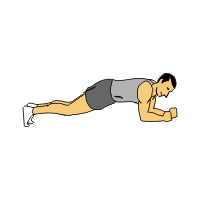 Prone Bridge
In a face down position, balance on the tips of your toes and elbows
while attempting to maintain a straight line from heels to head. This
exercise focuses on both the anterior and posterior muscle groups of
the trunk and pelvis.
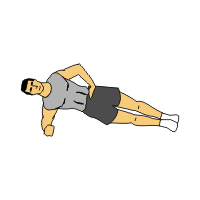 Lateral Bridge
Start on your side and press up with
your right arm. Form a bridge maintaining a straight line from your
hand to your foot. Rest on your elbow to increase the difficulty. This
exercise focuses on the abdominal obliques and transversus abdominus
Supine Bridge
Lying on your back, raise your hips
so that only your head, shoulders, and feet are touching the floor. The
supine bridge focuses on the gluteal muscles. Stronger gluteals help
maintain pelvic control
 Pelvic Thrusts
Lie on your back with your legs bent
90 degrees at the hip. Slowly lift your hips off the floor and towards
the ceiling. Lower your hips to the floor and repeat for the prescribed
number of repetitions.
 Russian Twists
1. Start by sitting on the floor with hips and knees flexed to approximately 90 degree angles.
2.
Grasp a medicine ball or small dumbbell and swing it to the right and
left as you keep the hips from rotating with the shoulders.
3. The arms are not perpendicular to the torso, but instead, kept low,
near the thighs, as the medicine ball is swung to each side.
 Good Mornings
1) Stand with feet shoulder width apart with knees slightly bent (at 20).
2) Start position: Grasp bar with overhand grip shoulder width apart. Back should be straight in a neutral position.
3) Bending at the hips, lower bar to approximately knee height. Keep knees bent at 20 throughout movement.
4) Return to start position.
5)
Remember to keep back straight - movement should occur at the hip. To
facilitate this, shift glutes back as if ready to sit down. Knees
should not move forward beyond the toes.
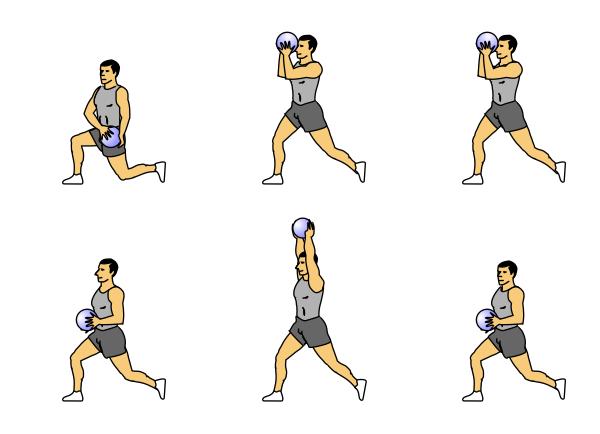 Dumbell Lunges with Crossover
1) Start position: Stand with feet hip width apart. Grasp DB's and hold out in front of body.
2)
Step forward 2-3 feet forming a 90 bend at the front hip and knee. DO
NOT allow front knee to extend past the big toe - may cause injury. As
you are lunging swing dumbbells across body towards the hip.
3) Pushing off front foot, return to start position with legs and dumbbells.
4) Remember to keep head and back upright in a neutral position. Shoulders and hips should remain squared at all times.
5)
Watch for proper knee alignment - do not let front knee extend past big
toe or deviate laterally or medially. Back knee should not come in
contact with floor.
Other excellent core stability exercises include:
Lat Pull Downs
Leg Presses/Squats
Crunches and crunch variations
Regular lunges
Back extensions
Deadlifts
Chin-ups
